
Blue Table Post has helped finish many films made by the Cornell Lab of Ornithology’s Conservation Media team. Here’s a look at their fascinating and important work.
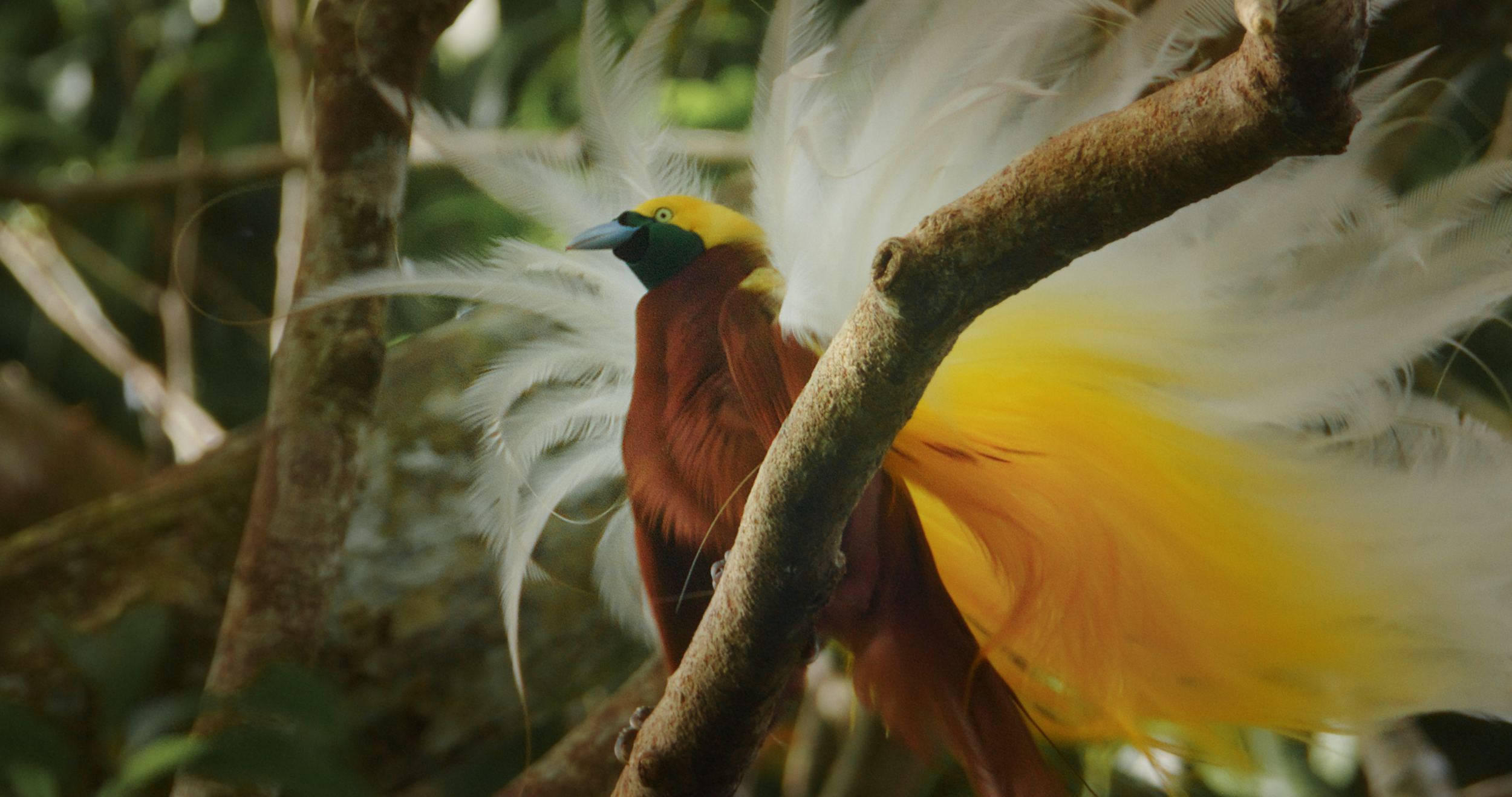
A bird-of-paradise is famous for its feathers. Less famous is what happens after it eats.
Most of us not lucky enough to have seen a bird-of-paradise up close have seen one in a nature documentary, the male strutting and dancing in an elaborate display of color to attract a mate. Dumbstruck by the show, we may have missed its not-so-dignified eating habits. It regurgitates large seeds that drop from its mouth to the forest floor. Even when a male fails to win a mate, his bad table manners help plant trees far and wide, building and sustaining the forest.
The forest that birds-of-paradise help sustain stretches across more than 730,000 square kilometers of Indonesia and Papua New Guinea. It holds an estimated 7 percent of the world’s species and more than 20 billion metric tons of carbon. Most of it remains standing, but logging, mining and agricultural expansion are pressing into a landscape whose remoteness has long helped protect it.
This is a conservation problem of an unusual kind. The aim is not to restore a vanished forest, but to keep a living one intact and make this apparent to decision makers before the damage is done.
A beautiful film can perform that role, enchanting on the surface, while also moving people to take action.
A camera in the service of conservation
The films are developed with partner organizations and co-designed to enhance and amplify their conservation strategies. Together, the team and its partners identify the people whose decisions could help a threatened species or habitat, such as government officials, local residents or landowners, and shape each film for them. The films are then distributed, often in local languages.
For editor and producer Tom Swartwout, the desired result is specific.
“We want them to understand the science, in some cases feel a sense of urgency, and finally know that something can be done,” he says. “Ultimately, we hope behavior changes.”
He recalls four films about ranchers in the Northern Grasslands. The ranchers had a practical way of describing the link between conservation and their livelihoods: “What’s good for the herd is good for the bird.” Grazing practices that maintain healthy cattle also help preserve bird habitats. Focusing on the ranchers’ lives made the science relevant to the people who could use it.
That’s why the films need human stories as well as extraordinary animals: stories hold an audience long enough for the science to land.
From Sidney Lumet to the rainforest
Tom came to conservation filmmaking from both scripted and documentary work. In New York he edited features for Sidney Lumet, including Find Me Guilty and Before the Devil Knows You’re Dead, while also cutting documentaries and documentary television.
In 2005 he edited Arctic Rush, a New York Times documentary about the consequences of melting Arctic ice. “It put climate change front and center for me in a way it hadn’t been before,” he recalls. He began looking for work that “might be useful to others.” A move to Ithaca with his young children eventually brought him to the Cornell Lab of Ornithology, known to many through its Merlin app, which identifies birds by their songs. The Lab’s mission is “to interpret and conserve the earth’s biological diversity through research, education, and participatory science focused on birds and nature.”
These days, Tom might be constructing a story about scientists tracking a cassowary, an elusive flightless bird that can weigh 150 pounds and stand over six feet tall. He might be working on a film about conserving native grasslands in the U.S. Great Plains, or one that uses the dazzling displays of birds-of-paradise to persuade stakeholders to protect their habitat. He brings the craft of filmmaking, and his feel for beauty, to the service of action.
The art of finishing
For years, Tom has brought the Cornell Lab’s films to Blue Table, where Brian Boyd handles color grading and Rich Cutler sound design and mixing. This long relationship makes for a smooth creative collaboration.
“Brian and Rich have each worked on enough of our films that we rarely have to explain what we’re after,” says Tom. “Brian takes footage from a wide range of cameras, sometimes shot years apart, and makes it feel like it all comes from one place. Many of our cinematographers started as photographers and are exacting about how their images look, and the work put into capturing those shots in the field is respected and carefully enhanced in the final grade.”
Brian explains the challenge. “I always say that it’s not that hard to make a shot look great in color. Color correction is about making hundreds or thousands of shots from different cameras feel cohesive. Matching different grain structures or sharpening or softening here and there. Matching the colors isn’t enough. The soul of the shot has to match.”
The grade has to be accurate and also guide the viewer’s attention. “When working with the Lab, the birds are the stars. I don’t know exactly what some of these birds are supposed to look like. For example, this bird’s neck plumage should skew more purple than blue for the females. This information is vital in the notes process. I want the birds to look beautiful and accurate. The trickiest thing is focusing the eye on the bird. You have this beautiful setting and we need the viewer to focus on the bird first, then take in the rest of the frame. This is accomplished by utilizing mattes to highlight or play down parts of the frame to guide the viewer’s eye.”
Sound faces a similar challenge: making the films feel full and rich while keeping what matters most in the foreground.
“The natural world is a noisy world,” says Rich. “And sometimes birds, wind and other animals interfere with the dialogue recording. Ensuring that the voices are clean and strong, while feeling embedded in a three-dimensional world, can take some time.”
“Rich seems to know what each moment needs with very little discussion,” says Tom. “The right amount of forest ambience, a clean entrance for a music cue, the balance of the voices. A mix can involve a lot of revisions, and I know how much work goes into making it feel easy. That ease is what I value most about working with both of them.”
Tom sums up what motivates him every day: “The natural world is stunning, and many people never get to experience it. If we’re doing it right, we hold their attention long enough for them to understand and then feel something. As filmmakers and scientists, we want to be moved by the work as much as anyone, and we try to share that experience widely. We’re fortunate to be supported by the birding community, which gives us the resources to work with experienced, talented filmmakers like those at Blue Table.”
When a finished film leaves Blue Table, it may reach an audience halfway around the world, people moved by its beauty and its message to act on behalf of our planet. Like the birds-of-paradise, the best of these films are both beautiful and useful.
Have a film in the works?
From documentaries to features, our color grading and sound teams can help bring your project to the finish line.